5 FP&A trends in 2026: From reporting function to value creation engine
Let’s start with a simple question. If I pause right now and ask, “What does FP&A actually do in your organization?”, most answers still sound like this: budgeting, forecasting, variance analysis, and monthly decks. That’s exactly the problem. After spending nearly 15 years in FP&A, strategic finance, and business partnering, I can tell you one thing with certainty: FP&A is standing at a turning point. The way FP&A worked in 2015—or even in 2025—will not survive in 2026.
We’re already operating in a VUCA (volatile, uncertain, complex, and ambiguous) world, and leadership no longer wants explanations after things go wrong. They want answers before they do. They want a Finance function that will connect strategy to execution, anticipate risks, and guide decisions in real time.
So, that leaves the big question: What will FP&A look like in 2026 and are you ready for it? In this article, I’ll break down five major FP&A trends shaping 2026, and more importantly, what you must do to stay relevant, valued, and future-proof. Importantly, these five trends all have one thing in common: they accelerate how quickly Finance can move from reporting results to shaping outcomes. But teams don’t make that leap overnight.
FP&A maturity follows a predictable path, with each stage defining how Finance creates value for the business. Before diving into the trends themselves, let’s anchor on a simple maturity model that explains where FP&A teams are today—and what “leading” really looks like in 2026.
FP&A 2026: A maturity model for the next decade
Over the years, I’ve noticed a pattern across organizations, industries, and geographies:
FP&A doesn’t transform overnight. It evolves through clear stages.
To make sense of where FP&A is headed in 2026, it helps to view these changes through the lens of a simple maturity model, which I call the “FP&A 2026 maturity model”. At its core, this model describes how Finance evolves from reporting outcomes to actively shaping them:
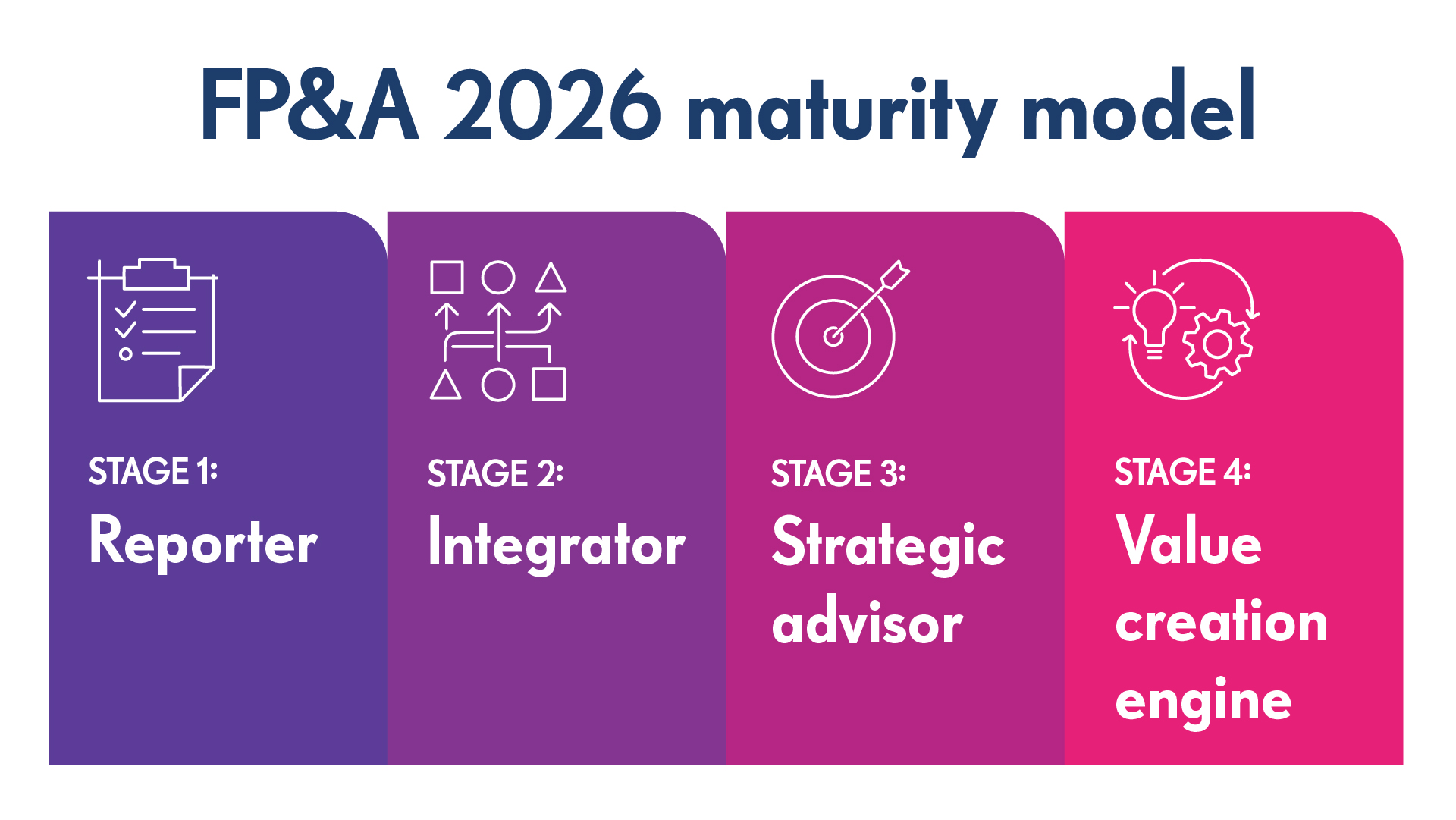
The evolution of financial planning and analysis is not about tools or titles; it’s about how Finance creates value. This maturity model shows the four distinct stages through which Finance functions evolve as business complexity increases.
This framework helps organizations assess where their FP&A function stands today, identify capability gaps, and define a clear target state for 2026
Stage 1 – Reporter: What happened?
FP&A focuses on historical reporting and variance explanations. Most FP&A teams start here, and, unfortunately, many get stuck here.
| Core characteristics | Typical outputs | Limitations |
|---|---|---|
|
|
|
Stage 2 – Integrator: What’s happening across the business?
FP&A connects data across functions to create a single version of the truth. This is where FP&A starts earning a seat at the table.
| Core characteristics | Typical outputs | Limitations |
|---|---|---|
|
|
|
Most FP&A teams today operate somewhere between the reporter and integrator stages.
Stage 3 – Strategic advisor: What should we do next?
At this stage, FP&A actively influences business decisions through insight and foresight.
| Core characteristics | Typical outputs | Value shift |
|---|---|---|
|
|
|
At this stage, FP&A is trusted but not yet transformative.
Stage 4 – Value creation engine: How do we create sustainable value?
This is the target state for Finance teams in 2026. FP&A becomes a proactive engine for value creation and resilience.
| Core characteristics | Typical outputs | Value shift |
|---|---|---|
|
|
|
This is what FP&A leadership looks like in 2026. The FP&A journey is not about maturity of reports; it’s about maturity of decisions. Organizations that reach this final stage consistently outperform peers in volatility, profitability, and strategic agility.
That being said, this maturity model shows where FP&A teams can go, but not how they get there. That’s where the five trends shaping 2026 come in. Each one removes friction that slows maturity, strengthens Finance’s impact at a specific stage, or accelerates the move toward becoming a true value creation engine. Some teams will progress. Others will stall. The difference won’t be ambition—it will be how deliberately they adopt the capabilities that matter most.
With this lens in mind, let’s look at the five trends driving FP&A’s evolution in 2026.
Trend 1: From siloed planning to integrated business planning
Let’s be honest—traditional FP&A is breaking, and most FP&A teams are still trapped in a broken model with:
- Annual budgets that are outdated in three months
- Forecasts that are built in silos
- Endless excel reconciliations
- Leadership decks that explain the past but don’t shape the future
I’ve seen FP&A teams work 14-hour days only to be ignored in decision-making. Not because they’re bad at finance, but because the model itself is outdated. And this brings us to the first major shift of 2026: FP&A can’t afford to plan in isolation.
Sales has its forecast, Operations has capacity constraints, HR has hiring plans, and Finance has a budget. None of them talk to each other.
Integrated business planning (IBP) fixes this. FP&A becomes the value creation hub, connecting revenue, costs, capacity, headcount, and cash into one decision framework. This is where digital business twins, which are live models that simulate what actually happens when assumptions change, come in and support faster decisions and fewer rework cycles. Suddenly, FP&A stops asking “Can you send me your numbers?” and starts asking “If we do this, what breaks?”
In 2026, FP&A teams that don’t integrate planning will slow the business down.
Trend 2: AI moves from experimentation to embedded workflows
Now let’s talk about the elephant in the room… artificial intelligence (AI). Some FP&A professionals are excited. Many are apprehensive. I’ve heard everything from “Will AI replace FP&A?” to “Will forecasting even need humans?”, and even “Am I becoming obsolete?”
Here’s the truth: AI won’t replace FP&A. But FP&A professionals who don’t use AI will be replaced by those who do.
In the past, AI was a toy. A pilot. A demo. By 2026, AI will be embedded into FP&A workflows via:
- Auto-generated variance explanations
- AI-assisted forecasts
- Real-time scenario modeling during leadership meetings
But this is critical. AI is a co-pilot, not an autopilot. Humans must still govern assumptions, apply business judgment, and own decisions. The FP&A professional of 2026 isn’t replaced but, ideally, augmented by AI that’s explainable, governable, and provides trusted outputs.
Trend 3: Massive scale-up of data integration
In 2026, internal data alone is no longer enough. FP&A teams will need external signals—market demand shifts, pricing trends, inflation data, and customer behavior—to produce forecasts leaders can actually trust. When forecasts ignore what’s happening outside the business, they become backward-looking the moment they’re published.
Consider the following: How much time does your FP&A team spend reconciling numbers, fixing data mismatches, or arguing over “whose number is right”?
The answer? Too much. That’s because FP&A used to live only inside the general ledger (GL), but that world is gone. In 2026, FP&A connects ERP data, CRM data, pipeline data, HR headcount metrics, operational KPIs, and external market signals all in one single source of truth.
The more data sources FP&A can integrate automatically and consistently, the higher the quality of forecasts and the stronger the trust in the numbers. When everyone works from the same, connected data foundation, debates shift from whose numbers are right to what decision should we make next.
Why does this matter? Because better data = faster decisions. When automation handles the plumbing, FP&A can focus on insight, not input.
Trend 4: Driver-based + continuous planning
Here’s a harsh truth. If you’re still managing the business with an annual budget, you’re using the rear-view mirror. FP&A in 2026 focuses on drivers, not line items. For example, when volume assumptions change, forecasts must update instantly.
Instead of debating travel expenses, we must model volume, pricing, conversion rates, capacity, and productivity. And with rolling forecasts, plans update continuously. I’ve seen companies move from quarterly reviews to weekly decision cycles. That’s the power of continuous planning.
Trend 5: FP&A as profitability guardian
Finally, growth alone is no longer enough. In a VUCA world, unprofitable growth is fragile. FP&A is now expected to answer questions like:
- Where are we actually making money?
- Which customers destroy the margin?
- What happens if demand drops 10%?
In 2026, Finance teams must focus on scenario planning to protect margins and making faster decisions that result in better capital allocation. These shifts become non-negotiable as FP&A shifts from the cost police to strategic advisors.
Conclusion: How to get ready for FP&A in 2026
So, here’s the big takeaway: FP&A in 2026 is not about better spreadsheets; it’s about better decisions. But FP&A’s shift toward value creation doesn’t happen overnight—it requires clear priorities. Teams that want to stay relevant in 2026 should focus on a few foundational moves:
- Adopt IBP to connect Finance with Sales, Operations, and HR
- Invest in governed AI use cases that enhance human judgment, not replace it
- Expand data integration across internal and external sources to improve trust and accuracy
- Move to continuous, driver-based planning for faster, more adaptive forecasts
- Build strong scenario and profitability capabilities to navigate volatility with confidence
FP&A professionals who cling to the old model will struggle. But those who embrace integration, intelligence, and influence will become indispensable.
The future of FP&A isn’t about adapting quietly but leading decisively. And the real question isn’t whether FP&A will change by 2026, but whether you will change with it.