AI lock‑in: The hidden threat undermining human expertise
Recognizing the risk of skill erosion
The conversation about AI in business is too often framed around speed, scale, or disruption. Yet beneath the surface lies a more fundamental question: what happens to human expertise when we stop exercising it? This is the question Gartner tackles in its latest analysis on “AI lock-in”, a growing strategic risk that goes beyond technology and directly affects organizational capability.
Gartner warns that automation is creating a new kind of lock-in: AI lock-in. This happens when employees abandon foundational tasks and rely solely on AI, causing essential expertise to decay. Without these skills, teams can no longer question or improve AI results or fix errors.
In fact, Gartner predicts that by 2028, 40% of employees will be trained by AI instead of humans and mentoring opportunities will shrink. Unchecked automation could push half of enterprises into irreversible skill shortages by 2030. AI agents will handle a third of decisions by 2028, but relying on algorithms without human oversight risks errors and reputational damage.
Crucially, Gartner also frames AI lock-in as a systemic risk: once core expertise has been hollowed out, the organization’s overall resilience—its ability to respond, recover, and innovate—is weakened. And because these capabilities cannot be rebuilt overnight, reversing the loss of institutional knowledge can prove extremely difficult, if not impossible.
What is “skill erosion”?
Skill erosion occurs when people stop performing foundational tasks themselves and instead rely entirely on AI. Over time, their ability to question, interpret, or improve AI-generated outputs weakens. This leads to a decline in institutional knowledge, reduced adaptability, and a higher risk of errors going unnoticed—all of which make organizations more dependent on technology and less capable of acting independently.
Beyond efficiency: Re-centering people
Rather than rejecting AI, Gartner urges leaders to invest in skill development and retention so that human expertise complements automation. Their recommendations include monitoring AI errors, retaining experienced staff, performing manual checks, and focusing on roles most exposed to automation. They also suggest pairing AI with human oversight and encouraging employees to practice critical skills both through hands-on work and AI-driven simulations.
Industry voices expand on this view—but underline that the solution is not to slow down AI adoption, but rather to use it in the right way. Dr. Rolf Gegenmantel, Chief Product Officer at Jedox, notes that in Finance, precision has always been non-negotiable. “For generations, controllers and Finance teams have been trained to stand behind their numbers—to understand them, explain them, and defend them,” he says. In that context, AI should accelerate work and broaden analytical horizons, not take ownership of complex decisions.
Gegenmantel argues that AI delivers its true value when it enhances the speed, scale, and scope of analysis—handling vast data volumes, exploring alternatives, and surfacing insights—while humans remain accountable for the why and how behind each decision. “Executives must still be able to explain how a conclusion was reached and why it makes sense,” he adds. “If that understanding is lost, leaders stop learning, stop questioning, and eventually stop steering. That’s when organizations shift from using AI to being used by it.”
The role of upskilling and human-centered design
The skills gap is already slowing adoption of generative AI. A recent McKinsey survey found that 47% of C-suite leaders believe their organizations are developing and releasing AI tools too slowly due to talent shortages; 46% cite AI-specific skill gaps as the main barrier.
McKinsey advises companies to hire AI specialists and commit to upskilling programs that involve non-technical employees in early projects. Leaders should be transparent about new skill requirements and create human-centric development strategies so that AI becomes a partner that increases human agency rather than a threat.
A sustainable AI approach with JedoxAI
Gartner’s analysis shows that AI lock-in is not inevitable; it’s a management choice. Organizations that combine AI with deliberate upskilling, role redesign, and vendor flexibility will avoid talent shortages and protect their strategic agility.
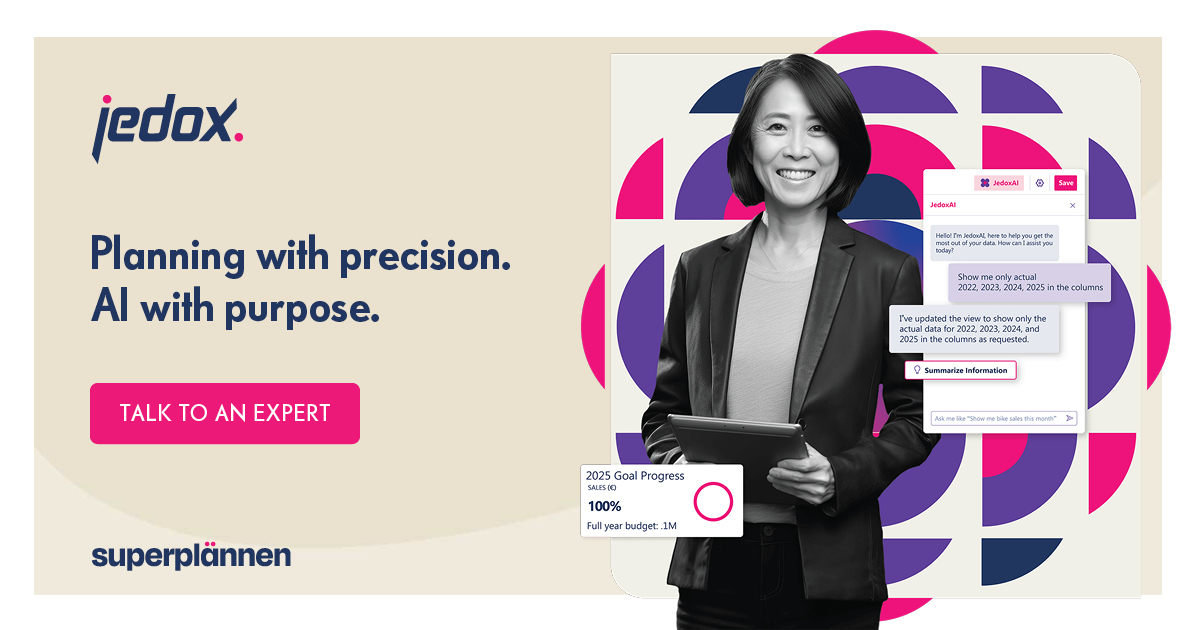
At Jedox, we take a fundamentally different approach to AI in enterprise planning. Our philosophy is built around one simple principle: augment professionals, don’t replace them. JedoxAI is designed to strengthen existing Finance and Planning teams—not to thin them out. By automating repetitive tasks and data workflows, the platform frees experts to focus on high-impact, strategic decisions that create real value for the business.
JedoxAI keeps the human in the loop. Domain experts remain actively involved at key checkpoints, make critical decisions themselves, and maintain full visibility over how AI-generated outputs are created. Built-in audit trails ensure that every recommendation and forecast remains transparent and explainable—addressing one of the main concerns highlighted by Gartner.
In this way, JedoxAI enables organizations to scale automation responsibly while preserving the expertise, judgement, and accountability that drive long-term performance.